You buy minutes from carriers and sell those minutes to other carriers. Or you sell phones, extensions, and a reseller login to the people who make the calls. The first business needs a Class 4 softswitch. The second needs a Class 5 softswitch.
Kolmisoft sells them as two products. M4 is the Class 4 switch. MOR is the Class 5 switch. You cannot upgrade a MOR system into M4. The architecture is different.
Two businesses, two switches
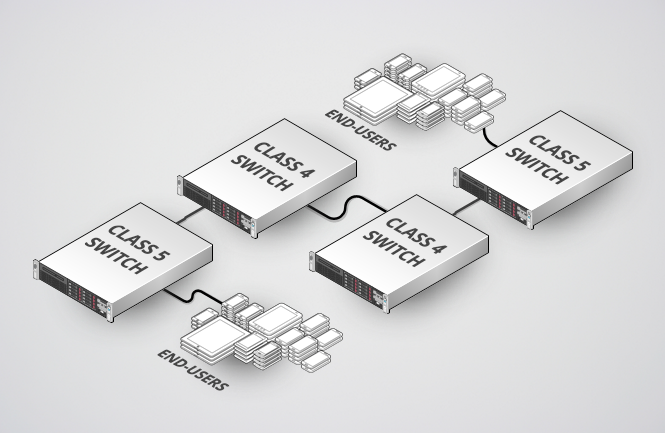
Three suppliers send you termination. Two customers buy that termination from you. Those customers are other carriers. There is no voicemail box and no extension login. You keep price lists, choose the cheapest route, and settle with the carriers. That traffic is Class 4.
A retail operator sells hosted PBX seats. One customer is a reseller with his own users, and calling cards run on the same platform. Phones register, and some of those phones sit behind NAT. That traffic is Class 5.
JeraSoft wrote on 26 February 2026 that using a retail platform for wholesale is a common mistake that leads to billing errors. ASTPP wrote on 31 July 2026 that a Class 5 switch handles subscriber features such as voicemail and IVR, and a Class 4 switch handles traffic between carriers. Further down, that ASTPP page calls a Class 5 softswitch the foundation for the wholesale work, and the FAQ says many modern platforms support both. Those later sentences contradict the definition ASTPP gave first. Kolmisoft sells M4 and MOR as separate products.
What each product is for
M4 is a Class 4 softswitch for wholesale traffic: aggregation, exchange, transit, and call termination. MOR is the retail switch: SIP trunking, calling cards, callback, call shops, and resellers. MOR is not optimized for wholesale, and the same wholesale tasks take longer on MOR.
The public MOR vs M4 comparison lists the features:
| MOR | M4 | |
|---|---|---|
| Job | Class 5: end users, billing, resellers, PBX features | Class 4: high-volume SIP routing |
| Engine | Asterisk | Kamailio, SEMS, RTPEngine |
| Signaling | SIP, H.323, IAX2 | SIP |
| Resellers | Yes | No |
| PBX (IVR, ring groups, voicemail, queues) | Yes | No |
| Recordings, call spy, auto-dialer, calling cards, callback | Yes | No |
| Many clients registering from behind NAT | Recommended | M4 can pass NAT. Many clients on one address belong on MOR |
M4 uses different names. An origination point is a MOR device. A termination point is a provider. A routing group is the LCR. A dial peer is LCR for a set of destinations. On M4 you set the tariff and the route on the device. On MOR you set them on the user.
Capacity
The MOR vs M4 comparison gives these limits when the GUI is quiet and you are not transcoding.
| Concurrent calls | Calls per second | |
|---|---|---|
| MOR, one server | up to 500 | up to 50, and closer to 20 most of the time |
| MOR, several servers | up to 2,000 | up to 100, and closer to 60 most of the time |
| M4, one server | up to 500 | up to 100 |
| M4, several servers | up to 10,000 | up to 1,000 |
The comparison page gives the same limits, and it says the one-server MOR rate is closer to 20 calls per second in practice. Calls per second and concurrent calls count different things. Adding concurrent calls does not raise the calls-per-second limit.
The same capacity notes also record two MOR systems that carried wholesale transit on the recommended hardware:
- One server, 24 cores, GUI almost unused: up to 500 concurrent calls, and up to 1,500 call attempts per minute.
- Four servers (a SIP balancer, three Asterisk servers, and a separate database and GUI server): 1,200 concurrent calls, and 1,500 call attempts per minute.
On several servers, M4 goes to 10,000 concurrent calls and 1,000 calls per second. You lose capacity when you transcode, record calls, run an IVR, generate invoices, or accept many short dialer calls. Each of those reduces capacity.
Which business you are running
Carriers as customers, trunks with fixed IP addresses, and routing and rating between those carriers: that is M4.
Subscribers, resellers, or any of these features: IVR, voicemail, queues, recordings, call spy, calling cards, callback, or an auto-dialer. That is MOR. Many clients registering from behind NAT is MOR as well. The comparison page says M4 can pass NAT, and that many clients registering from one address belong on MOR.
MOR can send a SIP-registered user to a chosen provider based on the dialed number, through localization rules. M4 cannot do that when the customer has no fixed IP and connects by registration. An extension that must use a different carrier for different numbers stays on MOR.
Both businesses means both products. The answer to “Can it be upgraded from MOR?” is no.
On the comparison page, resellers are a MOR feature and the M4 cell is empty. Multi-level resellers are unsupported. A hosted-PBX reseller with his own users belongs on MOR. A high call volume does not move that reseller onto M4.
FAQ
What does a Class 4 softswitch do?
It routes and rates traffic between carriers: termination, origination, and transit. On Kolmisoft that product is M4. Voicemail and IVR are the Class 5 side.
What does a Class 5 softswitch do?
It serves the people and resellers who make the calls: SIP trunks, PBX features, calling cards, callback, and recordings. On Kolmisoft that product is MOR. MOR is not optimized for wholesale.
Can one Kolmisoft switch do wholesale and retail?
Wholesale goes on M4. Retail, resellers, and PBX features go on MOR. A MOR install does not become M4.
How many calls does each product document?
With a quiet GUI and no transcoding: MOR up to 500 concurrent calls on one server and 2,000 on several servers. M4 up to 500 on one server and 10,000 on several. Calls per second: 50 (closer to 20) and 100 (closer to 60) on MOR, and 100 and 1,000 on M4. Documented wholesale examples on MOR reached 500 and 1,200 concurrent calls, both at 1,500 attempts per minute.
Open the page that matches the traffic
Carrier-to-carrier traffic starts at M4. Resellers, PBX features, or phones behind NAT start at the MOR vs M4 comparison, and that business stays on MOR.
Wholesale traffic goes on M4
Retail users, resellers, and PBX features stay on MOR. A MOR system is not upgraded into M4.