A supplier price list lands on Monday. A destination that cleared a margin last week now costs more than the price you sell, and the switch still completes the call. That is the wholesale billing problem: a new file each week, a buy price and a sell price on the same destination, and a busy hour a retail PBX does not see.
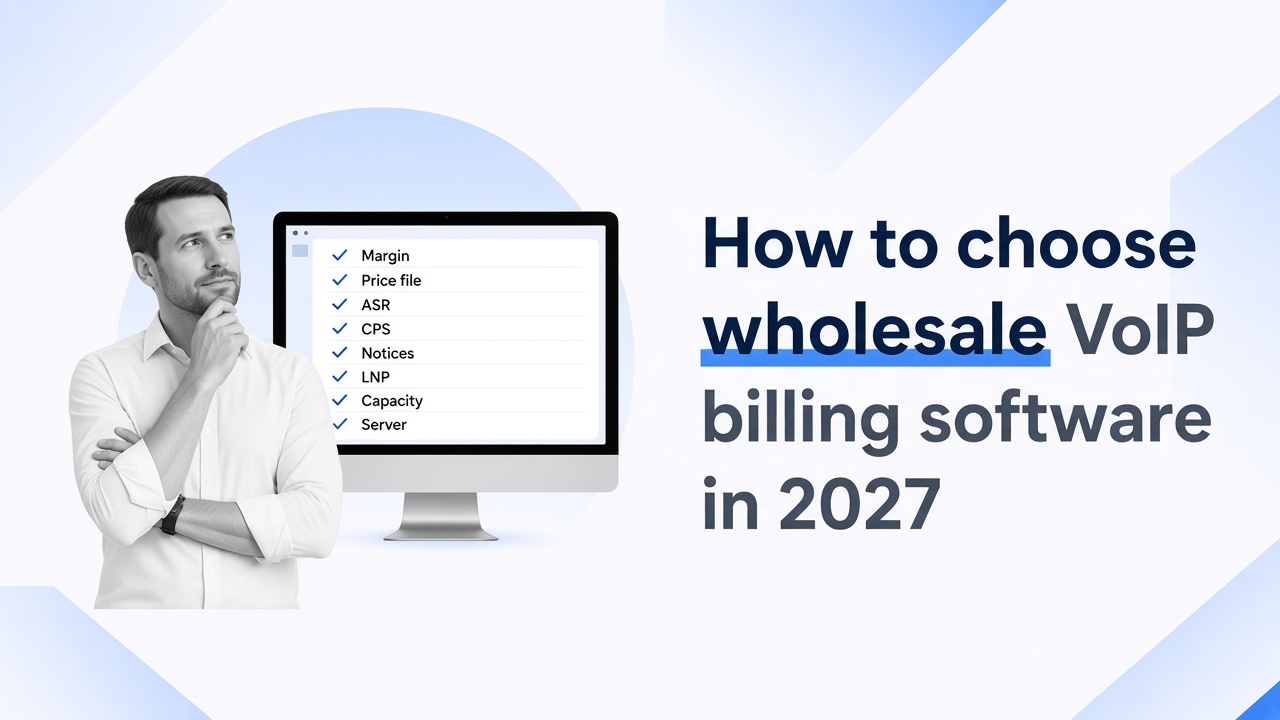
Eight tests follow. M4 is the worked example, in its own box, because we sell it.
If the person on the phone is your customer, start with MOR or M4 and take the Class 5 switch. Stay on this page when you sell minutes to another carrier. That transit is the Class 4 job, including a wholesale SIP trunk.
What wholesale billing has to do
Retail billing sells a package, a DID, or a subscription. Wholesale billing sells minutes to another carrier and buys those minutes from someone else, destination by destination.
The platform prices the call from the sell tariff and the buy tariff in force at the start. A row dated for next week is not today’s price. Buy and sell stay as two prices. The next supplier file has to land without a fresh column map. If the buy price is too high, the switch skips that supplier or refuses the call. The CDR answers a supplier invoice with prefix, duration, buy price, and sell price.
Eight tests for any vendor
- Margin floor. Can you set a minimum profit per minute as an amount and as a percent, and does the switch skip the supplier, refuse the call, or book the loss?
- Supplier ASR and ACD. When one supplier’s answer ratio or average duration falls away from a reference supplier on the same route, who gets an email?
- Price-file import. Can the same layout arrive by email next week and wait for a person to accept a rise with short notice?
- Notices to customers. Before a sell price changes, can the customer accept or refuse, and what happens to that destination on a refusal?
- CPS limits, and a message when they hit. Can you cap attempts per second on a customer and on a supplier, and does anyone hear when the extra attempt fails?
- LNP and MNP. Can the route follow a portability record, or does the switch have the digits the caller sent and nothing else?
- Capacity. What concurrent calls and what CPS were measured on one server and on several, and can the licence sit below the hardware?
- Hosted or your server. Who patches the system, and does the price change with that choice?
Worked example: Kolmisoft M4
We sell M4. The passes below are what M4 does. The four groups further down are the other ways to buy, and M4 is not one of them.
Margin floor
On a dial peer, Minimal Rate Margin is an amount per minute and Minimal Rate Margin Percent is a percent. The peer uses a termination point when the profit clears that floor. Other termination points on the peer can still take the call.
Example from the product settings. The customer pays 1 EUR per minute and the floor is 0.3 EUR, so the peer keeps a termination point at 0.7 EUR or cheaper and skips the rest. The default floor is 0, so a call at zero profit is allowed. A negative floor allows a loss.
The percent uses the buy price. You pay the provider 1 EUR per minute and the percent floor is 50. The customer rate has to be 1.5 EUR per minute or higher.
A second control sits on the user: Price Protection. Off is the default. On the amount or the percent, a call under the floor fails with hangup cause 324, rate margin is lower than allowed. The dial peer skips a supplier. Price Protection can refuse the call.
Supplier ASR and ACD
TP Deviation Observers (Reports → TP Deviations) compare each active termination point on a dial peer with one reference point on that same peer. The gap is a percent on ASR and on ACD, in the worse direction. You set how often it runs and how many minutes it reads. Email goes out when a point flips between OK and warning. If the reference ASR or ACD is zero, the other gaps show as zero. This is not last month against this month.
Price-file import
Automatic Tariff Import is an add-on, the same one on M4 and on MOR. One template records the sheet, the header rows, and the columns for prefix, destination, rate, and effective time. The next XLSX, including one inside a ZIP or a RAR, arrives at a mailbox. Rules can flag or reject a row, such as a rise with fewer than seven days of notice. A person confirms before the file becomes the buy price. You can skip that step. The import can update rows or replace the tariff.
Notices to customers
Rate Notifications (Billing → Tariffs → Rate Notifications) cover sell tariffs. The email carries an XLSX plus agree and disagree links. Delta sends future rates. Full also sends rates in force. No email goes out when nothing changed. You set a timeout in days and choose whether an ignored increase stays open or gets blocked. A disagree, or a block on ignore, builds a custom tariff with those rates blocked and assigns it to the origination point. If a conditional tariff is already on that point, the blocked tariff is created and not assigned. Assign it yourself, or the old prices stay in the route.
CPS limits, and how you hear about them
Limit up to X calls, during Y seconds caps CPS on an origination point and on a termination point. You can also cap one termination point inside one dial peer. A hit fails the attempt:
- 304, the originator’s CPS limit
- 329, the terminator’s CPS limit
- 342, the global incoming CPS limit
- 345, the terminator’s CPS limit inside that dial peer
Security → Alerts can watch ASR, ACD, simultaneous calls, price sum, and hangup-cause counts. The form has no field named CPS. For an email when a cap hits, alert on the hangup-cause count for 304, 329, 342, or 345. That alert can email a group and can disable the point.
LNP and MNP
M4 reads a MySQL-compatible database you maintain: dialed number in, routing number out. You load a full file from your LNP provider, then the delta files. An origination point can then bill three US cases, intrastate, interstate, and indeterminate (caller number not usable), using the routing number. You run that database. M4 does not dip a national mobile-portability service. Where your country uses MNP, test whether the provider file fits this table and whether a ported number takes the tariff you wanted.
Capacity
Published estimates, on suitable hardware, with no codec transcoding, no call recording, and light use of the web interface:
| Layout | Concurrent calls | Call attempts per second |
|---|---|---|
| M4, one server | Up to 500 | Up to 100 |
| M4, several servers | Up to 10,000 | Up to 1,000 |
These are estimates. Do not expect both ceilings together, on one server or on several. Short calls need more processing than the same number of long calls. A licence can sit lower than the hardware, and a standby server does not add capacity. Signalling, and audio carried on the server, are different loads. If your peak is past one server, the several-server row is the one to test, at your CPS, not at the top of the table. Concurrent calls, CPS, and servers explains that split.
Hosted or your own server
Both exist. On your server you run the host: 8 CPU cores, 32 GB of RAM, and SSD or NVMe as the production starting point, Rocky Linux 9, clock set to UTC. For M4 above 700 concurrent calls the NIC note names Intel I210, I350, or X550T, and names Realtek RTL8111/8168/8411 and Intel 82574L as weak. Hosted means Kolmisoft runs that environment. Which one you pick is part of the price.
Four groups, and no ranking
Kolmisoft is not in these four. Named notes sit on Compare Kolmisoft.
Self-hosted open source
Best for a team that will install and patch the servers and wants both call legs rated on the same system. Public pages in this group describe real-time rating of the customer leg and the supplier leg, with source and packages available. One Class 4 project states that the official install method is Debian packages, on Debian 12, amd64, and does not describe a second method.
Watch the scope, and watch who loads the next file. One project in this group calls itself free, with a lifetime licence, and lists Class 4, Class 5, calling cards, and a multi-tenant PBX together. Number portability appears in the same menu as its add-ons.
Carrier BSS suites
Best for an operator who wants charging, accounts, and the switch as one platform, and who will run a cluster.
Watch the size of the project. Public pages describe a billing system plus a SIP switch, used for wholesale and also for cloud PBX and SIP trunks. One wholesale page describes a remembered spreadsheet layout, an email forward for the next file, a profit-guarantee route, and a cap on call attempts per second. One licence page counts servers (billing engines and SIP nodes) and states that it does not cap concurrent calls, minutes, or end users. The second import, with nobody remapping columns, is the test.
Hosted Class 4 services
Best for an operator who wants the vendor to run the servers.
Watch the unit on the invoice. Public pricing pages size the fee on concurrent calls and state that minutes are not charged again, or sell a block of minutes and then charge per minute, or offer a rate per minute or a price per port. Compare that unit before you compare two quotes. Hosting does not answer the margin.
Low-cost Class 4 switches
Best for an operator who wants a Class 4 switch on their own server and will judge it with the eight tests rather than with the licence line.
A small starting price is not a pass. A download and a licence key do not show the Monday file, the margin floor, or the customer notice.
What the price follows
Vendors price this work in four ways:
- A software licence on a server you run.
- A hosted fee sized on concurrent calls.
- A hosted fee with a block of minutes, then a further charge per minute.
- A rate per minute, or a price per port.
At Kolmisoft the price follows four choices: MOR or M4, the add-ons you turn on, hosted or your own server, and the implementation your concurrent calls and CPS require. Automatic Tariff Import is an add-on, so turning it on belongs in that conversation. Adding customers, SIP accounts, DID numbers, carriers, or routes does not change the price, and those counts are not capped.
Run the file before you sign
Pick two destinations from last week’s supplier file: one where you expect a margin, and one where the new buy price sits close to your sell price. Ask each vendor to load that file at the CPS you peak at, and to show which supplier the switch selects and what profit is left per minute.
Send us one real supplier price list and your peak CPS, and say if that peak is past one server. On a Pilot Project we load that file on one server or on several, so the layout matches the peak, and we show which supplier is selected and the profit per minute. The mailbox that repeats the file each week is the Automatic Tariff Import add-on. The pilot still loads this file.
FAQ
What does wholesale VoIP billing cost?
A licence, a hosted fee, a fee plus minutes, or a rate per minute. At Kolmisoft, adding carriers or routes does not move the price.
Does a CPS cap also send an alert?
On M4 the cap fails the attempt. The email is a separate alert on that hangup cause. Ask any other vendor both questions.
Where do named platforms sit?
On the comparison hub. This article keeps the eight tests and the four groups.
Send one supplier price list and your peak CPS
On a Pilot Project we load the file and show the routing and the margin.