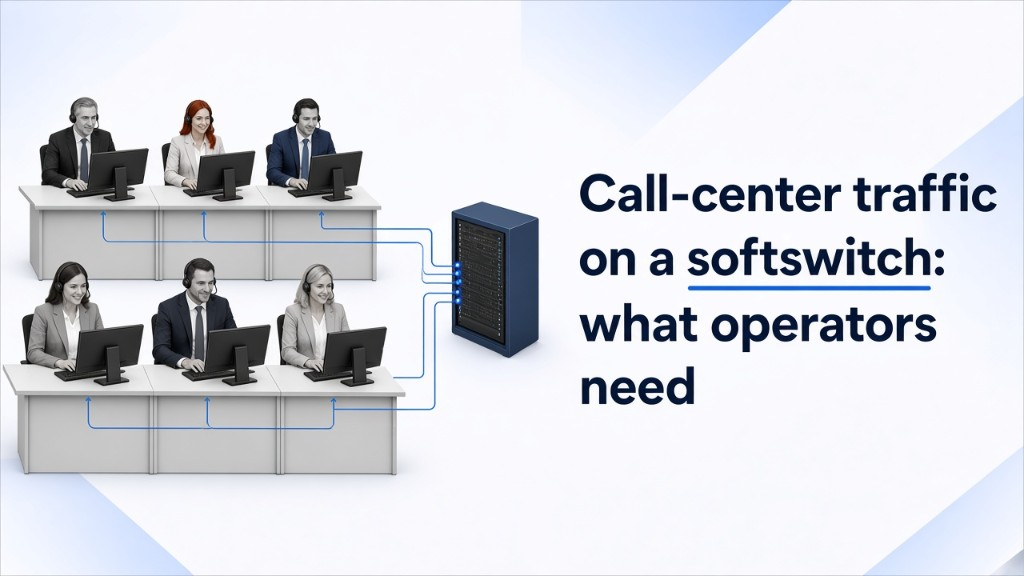
Office PBX traffic and call-center traffic both travel over SIP. That is where the similarity ends.
A predictive dialer can fire more attempts in one second than a small office places in a morning. Many of those attempts never answer. The ones that do often last less than a minute. Concurrent calls can still look calm while attempt rate, database writes, and balance checks climb.
If you sell minutes to dialer originators, or you run outbound campaigns through your own switch, you need a softswitch sized for that shape. Not a phone system with a higher concurrent-call licence.
Two different businesses share the same word
Contact-center software (queues, agent desktops, predictive dialers) is one product. Carrying and billing the voice path those dialers generate is another.
Termination sellers call the second product “CC routes”: wholesale capacity built for high calls-per-second (CPS), short average call duration (ACD), and answer rates that decide whether a campaign pays. Softswitch vendors sit one layer underneath. Your customers may run Vicidial, GoAutoDial, or a custom Asterisk dialer. You still have to authorize, route, rate, limit, and report every attempt.
Kolmisoft builds the softswitch and billing layer. We do not ship the dialer or the agent screen. Operators already pick their campaign stack; they need a switch that survives the traffic that stack produces.
For short definitions of dialer traffic, CPS, ASR, and ACD, see the VoIP business glossary.
What call-center traffic looks like on the switch
Outbound dialer campaigns often sit under about 20% answer seizure ratio (ASR), with many short answered calls. Predictive dialers may place on the order of 20–30 attempts to keep one agent busy with a live answer. Conversational wholesale and residential traffic usually sit higher on ASR and longer on call duration. Treat those figures as rough industry bands, not as your network’s measured reality.
In production the pattern is usually:
| Signal | Typical dialer / CC shape | Why the switch cares |
|---|---|---|
| CPS | Bursts at campaign start and during predictive pacing | Signaling and authorization load |
| Concurrent calls | Can look “reasonable” | Licence and media path |
| ASR | Often low | Many failed attempts still cost CPU and CDR writes |
| ACD | Often short on answered calls | Billing increment and route economics |
| Originator mix | One hot dialer can dominate | Per-account CPS limits matter |
CPS and concurrent calls are separate ceilings. A trunk can be fast at attempts and thin on live channels, or the reverse. Calls per second vs concurrent calls covers the math. Why dialers get 503s when channels still look free covers the operator failure mode when those numbers disagree.
Generic wholesale routes sometimes throttle or surcharge short-duration, high-CPS traffic. Dedicated CC routes exist because that pattern is normal for dialers, not proof that the route is broken. Your softswitch still has to bill and contain the same pattern on your side of the interconnect.
What the softswitch must actually do
1. Cap attempt rate per originator
A call-center PBX allowed at 10 CPS can still try 100 attempts in the same second. Softswitch platforms reject the excess (often with SIP 503) so one account cannot take down the node. Attempts also arrive in bursts (many calls in a few seconds), so limits have to cope with spikes, not only a neat one-call-per-second average.
On Kolmisoft platforms you set CPS limits per device or origination/termination point. Stated global guidance is on the order of ~100 CPS for MOR and ~1,000 CPS for M4, with architecture-dependent reality. Those are planning ceilings from our product documentation, not a promise that every deployment hits them.
When several dialers share one credential, they share one CPS bucket. Separate originators that need separate limits.
2. Keep concurrent-call licence and CPS in the same conversation
Sales talks often start with concurrent calls. Dialer traffic fails that framing. Two numbers belong in every go-live discussion:
- Licensed concurrent calls.
- Peak CPS from the largest originator (and total peak if many originators peak together).
If the second number is blank, both sides are guessing. We have watched operators ask for more concurrent-call headroom when the real wall was CPS. A licence bump does not raise attempt-rate capacity.
3. Bill and credit under attempt storms
Outbound call centers pay most attention to connects. Attempts still hit your prepaid balance checks, postpaid credit limits, and CDR pipeline. Low ASR means lots of signaling for little billable duration. Rating increments (per-second vs full-minute rounding) matter more when answered calls are short. Termination sellers publish worked examples where increment policy alone moves monthly cost by thousands of dollars at the same headline rate.
Your softswitch has to keep real-time authorization honest under that load, or you discover the damage in disputes after the campaign.
4. Route for quality when ASR is already low
Least-cost routing that only looks at price will push dialer traffic onto routes that cannot hold under high CPS and low ACD. Operators who carry CC originators need ASR/ACD (and related quality signals) in routing decisions, plus the ability to isolate a bad originator before it burns a vendor relationship. Which dialer customer burned your CPS route is the containment playbook.
5. Trace while the floor is on fire
When attempt rate spikes, the GUI and reports are under the same pressure as the signaling path. Live tracing and call lists that stay usable at peak are part of the product requirement, not a luxury. M4 call tracing exists for that job. If you cannot prove which originator, dial peer, or terminator failed during the burst, you cannot calm a customer who already has another vendor on speed dial.
6. Record when the business requires it
Smaller contact-centre stacks often need recording for quality or compliance. MOR supports recordings as an add-on path. High-volume wholesale CC feeding many third-party dialers usually leans on M4 for capacity first, with recording decisions made per account and storage plan.
7. Respect dialer hours where regulation demands it
Some markets limit outbound dialer windows. Time-period routing can reject or divert dialer traffic outside allowed hours. See Automating time-based routing for dialer calls with MOR.
MOR or M4 for this traffic
| Situation | Usual lean |
|---|---|
| Smaller dialer / CCaaS stack, recordings, richer Class 5 features | MOR |
| High-volume wholesale feeding dialer originators | M4 |
| Approaching or past ~1,000 CPS | Read when your voice business needs more than 1,000 CPS and talk capacity before you promise the deal |
MOR vs M4 SBC is the product comparison. The decision for call-center traffic is usually volume and CPS, not a feature checklist.
We do not sell Vicidial, a predictive dialer, or a branded softphone. If you need a turnkey dialer-plus-switch stack from one vendor, other platforms advertise that bundle. Our fit is the operator who already has (or will choose) a dialer and needs billing, CPS control, routing, and support that hold under attempt-heavy load.
Questions to lock before the first production week
Ask these of every dialer originator (and of yourself if you are the dialer):
- Peak CPS expected, not average.
- Concurrent channels at campaign peak.
- Main destinations and whether traffic is CLI, non-CLI, or mixed CC-route class.
- Expected ASR and ACD bands (even rough).
- Billing increment you will buy and sell on.
- Whether several campaigns will share one SIP account.
- What happens on SIP 503 from you or from your terminator (failover trunk ready?).
If you cannot answer (1) and (2), do not size the switch from concurrent calls alone.
FAQ
Is call-center traffic the same as business VoIP?
No. Business VoIP is extensions, voicemail, and staff calling. Call-center / dialer traffic is high attempt rate, often low ASR, often short ACD, with revenue tied to connects. Provision and bill them as different shapes.
Do I need a “CC route” and a softswitch?
Often yes, at different layers. A CC route is how you buy termination sized for dialer patterns. A softswitch is how you sell, limit, and bill that traffic to your own customers. Kolmisoft addresses the softswitch layer.
Why do dialers get 503 while channels look free?
Because CPS or another attempt-rate / authorization limit was hit, not because every concurrent channel was busy. See the dialer 503 post.
Can MOR’s Auto-Dialer replace Vicidial?
No. MOR’s Auto-Dialer add-on is a voice-broadcast style tool, not a full predictive contact-center dialer. Bring your own campaign platform; use MOR or M4 for the carrier path.
Closing
Call-center traffic is not more of the same wholesale. It is a traffic class with its own attempt rate, answer economics, and failure modes. Operators who serve it need per-originator CPS limits, honest concurrent-call vs CPS scoping, billing that survives attempt storms, quality-aware routing, and tracing that works at peak.
If you are sizing MOR or M4 for dialer or call-center originators, tell us peak CPS, concurrent calls, and destination mix. We will be clear about what the platform supports today.
Contact us to discuss capacity for call-center traffic.
Sizing a softswitch for call-center traffic?
Tell us peak CPS, concurrent calls, and destination mix. We will be clear about what MOR or M4 supports today.