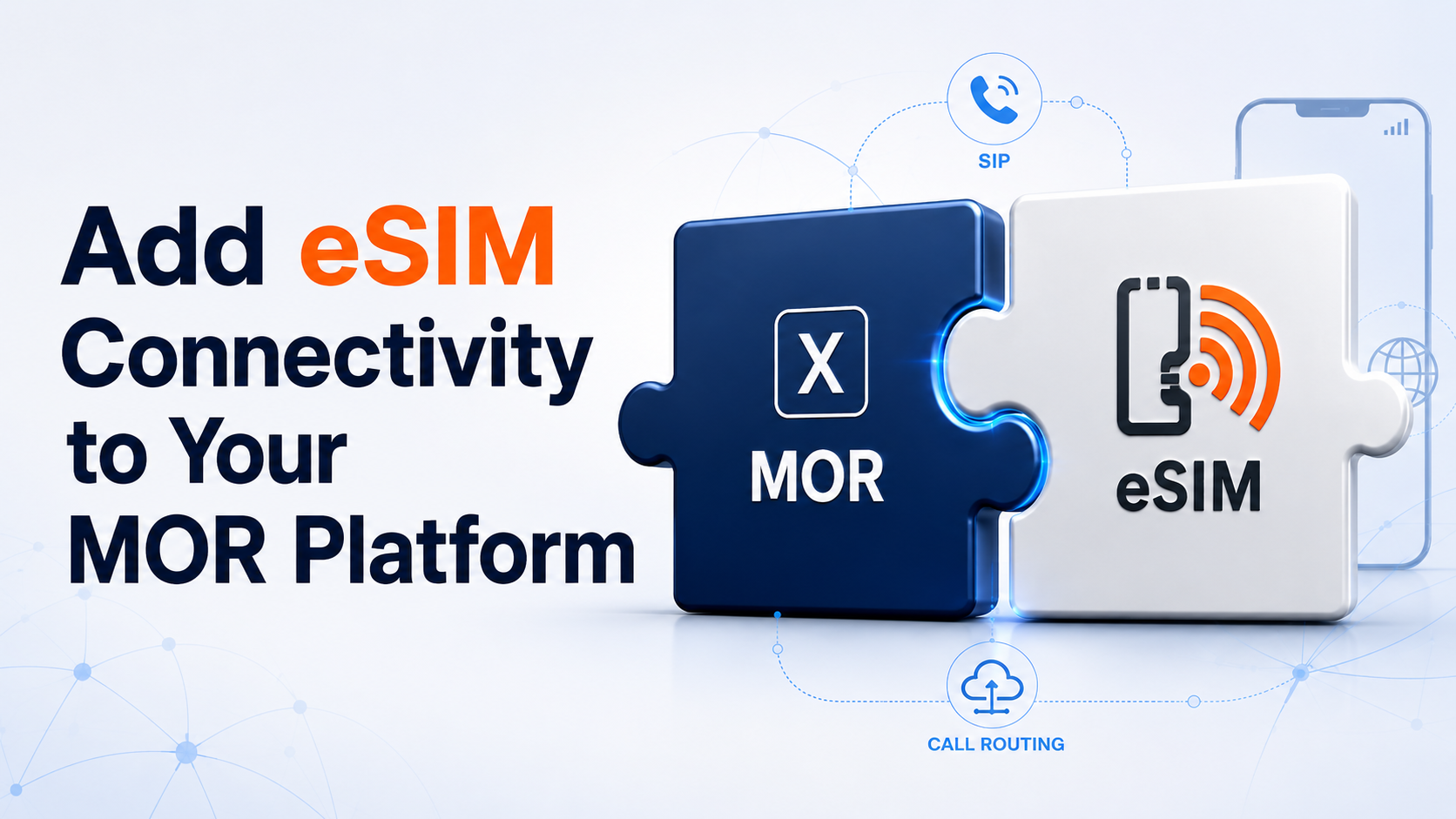
Many VoIP service providers use MOR as the core of their voice services.
For some, VoIP is the main service they sell. For others, it is one part of a wider telecom, ISP, cloud, or managed services portfolio.
In both cases, the same challenge appears: customers increasingly expect business communication to work not only at the desk, but also on mobile devices.
BHnet is a provider of business mobile, eSIM, and VoIP connectivity services. As a Kolmisoft client using MOR, BHnet has built an integration that connects eSIMs to MOR, allowing mobile lines to behave like SIP endpoints inside the existing VoIP platform.
For companies already using MOR, this creates a practical way to add mobile connectivity without replacing the core VoIP platform or moving customers outside the existing service ecosystem.
The problem service providers know well
When business users are in the office, VoIP is usually clear and controlled.
Calls go through the provider’s platform.
Routing, billing, reporting, call flows, and user management stay visible.
But when users leave the office, the experience often becomes fragmented.
They may start using call forwarding.
They may answer business calls from personal mobile numbers.
They may install SIP apps, but reliability, battery usage, mobile network changes, and user experience can become an issue.
At first, these may look like small workarounds.
But over time, they can mean:
- less visibility
- less control
- weaker reporting
- less consistent call handling
- reduced customer stickiness
- missed revenue opportunities
- more communication happening outside the provider’s platform
Your customer should be mobile.
But your service should stay under control.
Add mobile connectivity without replacing MOR
BHnet’s integration gives service providers using MOR a way to add eSIM connectivity to their existing VoIP service.
In practical terms, the eSIM can behave like a SIP endpoint inside the provider’s VoIP platform. This allows mobile calls to follow existing routing, caller ID, reporting, and call-control logic.
Instead of treating mobile as a separate product outside your platform, the mobile layer can become part of the customer’s communication setup, while MOR remains the core system for VoIP logic, routing, billing, reporting, and service control.
This can be relevant for service providers who want to offer:
- business mobile connectivity
- fixed-mobile style services
- mobile extensions for existing VoIP customers
- eSIM services as an add-on to current VoIP plans
- a more complete communication package for business clients
This also gives service providers a practical route into mobile services without the cost and complexity of building a full MVNO operation.
You keep the customer relationship.
You keep the call flow.
You keep the business communication inside your ecosystem.
Video 1: Connecting MOR to the BHnet eSIM platform
See how MOR can be connected to BHnet’s mobile eSIM platform, allowing mobile users to become part of the existing VoIP workflow.
Provision eSIMs and connect them to MOR
BHnet has simplified the mobile activation process.
Service providers can activate an eSIM through the BHnet portal or automate the process through API integration.
The workflow can include:
Customer → Plan → eSIM → MOR provisioning
For service providers using MOR, this means mobile service can be added as part of the existing customer onboarding or service expansion process.
Instead of sending customers to a separate mobile provider, you can offer mobile connectivity as an extension of the VoIP service you already provide.
Video 2: eSIM activation and automatic MOR provisioning
See how an eSIM can be activated and automatically connected to the MOR provisioning flow.
Why this can matter for service providers using MOR
If you already sell VoIP to business customers, mobile connectivity can be a natural next layer.
Your customers may already be asking for ways to stay reachable outside the office. They may already be using informal workarounds. The question is whether that mobile usage stays inside your service offering or moves somewhere else.
With this type of integration, service providers using MOR may be able to:
- add a new revenue layer to existing VoIP accounts
- increase customer retention
- reduce dependency on SIP mobile apps
- offer business mobile users a more integrated experience
- keep reporting, billing, and service logic closer to the existing MOR setup
- strengthen their position as the customer’s communication provider, not only their VoIP platform provider
For providers who offer VoIP as part of a wider service portfolio, this can also make the overall package more complete.
Built by a MOR user
This integration was developed by BHnet, an existing MOR user and Kolmisoft client.
It is a good example of how MOR can be extended through external integrations and adapted to different telecom business models.
Kolmisoft MOR remains the VoIP softswitch platform. BHnet provides the mobile eSIM connectivity layer and the related integration.
Voice calls, numbers, routing, caller ID, and regulatory obligations remain under the service provider’s responsibility, just as with other SIP devices, extensions, or trunks in their own VoIP platform.
Almost 20 years ago, I entered the VoIP industry while it was still in its infancy. After struggling with unreliable systems, I discovered Kolmisoft and have relied on the stability and reliability of the MOR platform ever since.
The COVID-19 pandemic changed business communication permanently. Remote work became standard, and VoIP providers had to support communication beyond office walls. SIP apps can help, but they are not a perfect solution.
Today, a native mobile SIM connected directly to a VoIP system is no longer a luxury. It allows businesses to manage call recording, AI transcriptions, complex call flows, and CRM integrations directly from a mobile device.
After extensive development, we achieved exactly that with eSIP, which bridges the cellular network with the VoIP platform. Naturally, MOR was the first system we integrated it with.
I’m confident this product will bring real value to the MOR community, and I want to thank Kolmisoft for years of outstanding partnership.
— Eli Lebrecht, Co-Founder & Managing Director, BHnet
Interested in making your MOR platform mobile-ready?
For full product details, pricing model, supported countries, and FAQ, visit:
https://bhnet.uk/voip-integrated-MOR
Disclaimer: BHnet is an independent company. Kolmisoft is not affiliated with BHnet and is not responsible for BHnet’s products, services, pricing, coverage, availability, or commercial terms.
Kolmisoft MOR remains the VoIP softswitch platform. BHnet provides the mobile eSIM connectivity layer and the related integration.